

A man who has spent any time around good objects develops a specific reflex.
He turns the thing over. He looks at the case back, the stitching on the inside of the collar, the way the lining is finished where nobody will see it. The reflex is not snobbery. It is a working method for telling the difference between a product that has been engineered and a product that has been styled to look engineered, and it is the single most useful habit in any category where money changes hands.
That reflex is worth carrying into a category most style writing ignores. Online casino products have become, over the last four or five years, some of the most heavily art-directed consumer software in the world. Deep navy and charcoal palettes. Restrained gold accents. Serif logotypes that would not look out of place on a decanter. Photography of studios lit like a members’ club. Since Alberta opened its regulated market to private operators on 13 July 2026, joining Ontario as the only two Canadian provinces where private operators run legally, a Canadian reader now has a genuinely crowded field of these products to look at.
If you want the map before the critique, Lineups maintains a province-by-province breakdown of canada online casinos that sets out who is legally available where, which is a more sober starting point than any operator’s own landing page. This piece is not about which one to pick. It is about a narrower and more interesting question: what all that design work is doing, what it is entitled to claim, and where the aesthetics stop being informative. Because the answer, stated plainly at the top so nothing that follows can be misread, is that the visual quality of these products has no relationship whatsoever to the mathematics inside them. The house edge is a fixed property of each game. No amount of typography moves it.
The visual grammar operators borrowed, and where they borrowed it from
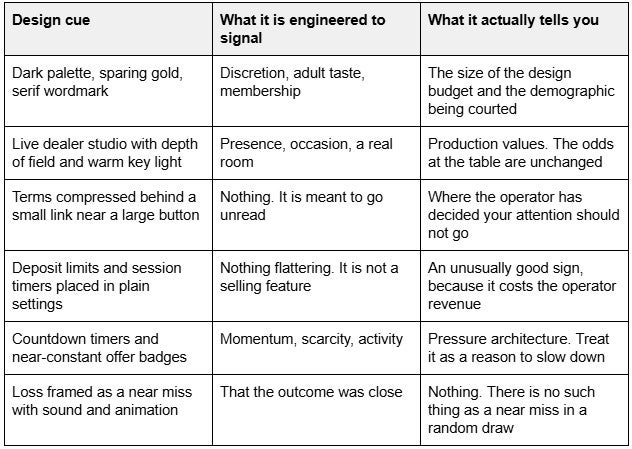
Look at a dozen of these interfaces side by side and the family resemblance is immediate. Dark backgrounds, because dark reads as evening, as discretion, as adult. Gold or brass accents used sparingly, because sparing use of gold is the oldest signal of restraint-as-wealth in the design vocabulary. A serif or a high-contrast sans in the wordmark, borrowed almost directly from spirits and fragrance. Generous negative space around the primary action.
None of this is accidental and none of it is new. It is the same grammar that watch brands, whisky houses and hotel groups have used for a century, applied to a category that historically looked like a fairground. The strip-lit, primary-color, exclamation-mark aesthetic of early online gambling did not disappear because it stopped converting. It disappeared from the top tier because operators wanted a different customer, and different customers respond to different signals.
What is worth understanding is the direction of causation. The design did not follow an improvement in the product. The games are, mathematically, close to what they were. What changed was the packaging and the audience it was aimed at.


Live dealer is set design, and it is very good set design
The most expensive visual investment in the category is the live dealer studio. These are real rooms with real croupiers, multiple camera angles, motorized rigs, color-graded feeds, and in the higher-budget productions a set dresser’s attention to depth of field so that a blurred bar or staircase sits behind the table.
As production, it is genuinely accomplished. It borrows from broadcast sport and from luxury hospitality in roughly equal measure. The lighting is warm and low. The dealer is trained in a register that sits between croupier and concierge. The whole apparatus is built to make a solitary activity on a phone feel like an occasion in a room.
It is worth being clear-eyed about what that production does and does not change. It changes the experience, which is a legitimate thing to sell. Presentation is not fraud. A hotel bar charges for the room as much as the pour, and nobody objects, because the room is what you came for and everybody understands the transaction. What the studio does not change is the distribution of outcomes at the table. A hand dealt by a person in a beautifully lit room and a hand dealt by a random number generator on a flat green background carry identical odds. The set is real. The advantage it implies is not.
What a discerning eye should actually be reading
There is a version of taste that stops at surface, and a better version that reads surface as evidence of process. In watches, the second version is why enthusiasts have moved toward thin cases and visible movement finishing over sheer size, a shift SWAGGER covered in its look at why mechanical integrity and slim profiles now define the flex. The point of that shift is that the aesthetic became a legible signal of engineering underneath.
Casino interfaces do not work that way, and this is the honest contrast rather than a flattering parallel. A beautifully finished movement tells you something true about the hours in the workshop. A beautifully finished casino interface tells you about the design budget and nothing else. The two look similar as consumer experiences and behave completely differently as evidence. Someone with a trained eye for objects is not, by virtue of that training, better positioned against a slot machine. Slots are pure chance. There is no craft to read.
What the surface can legitimately tell you is something narrower and more practical: how the operator has chosen to treat you as a user. That is readable, and it is worth reading.

Motion and sound do more persuasive work than color
Static screenshots undersell how these products actually feel, because the persuasion lives in motion. Reels that decelerate before stopping. A held beat before a result resolves. Coin sounds pitched slightly above a comfortable speaking register. Wins scored with a rising figure and animation that runs longer than the outcome warrants.
The near miss is the most studied of these. When two of three symbols land and the third stops just past the line, the design presents the result as though it were close. Statistically it was not close. Each spin is an independent event with a fixed probability, and there is no continuum along which an outcome can be nearly right. The animation is manufacturing a sensation of narrow failure where the mathematics contains only a result.
Reading this as design, rather than being carried by it, costs nothing. It is the same skepticism a well-dressed man applies to a fused canvas jacket that has been pressed to look hand-padded. Recognizing the technique does not spoil the object. It just prices it correctly.
Two Canadian markets, and what regulation does and does not fix
Regulation shapes the surface, and it is useful to know how. Ontario has run an open private-operator market since April 2022, administered by iGaming Ontario under the AGCO, with a minimum age of 19. Alberta’s market opened on 13 July 2026 under the iGaming Alberta Act, with the Alberta iGaming Corporation holding the commercial agreements and AGLC regulating, alongside the existing government-run PlayAlberta. Reporting around the launch put roughly 50 operators through registration with more than 20 sites live in the opening days, though that figure keeps moving. Alberta’s minimum age is 18, one year lower than Ontario’s, which is the kind of detail people assume is national and is not. Elsewhere in the country the provincial platforms remain the only legal option, Quebec included.
What a regulated market delivers is real: identity verification, advertising rules, complaint routes, mandatory tools. What it does not deliver, and does not claim to, is a better expected outcome for the player. A licensed product and an unlicensed one both run a house edge. The licence governs conduct, not arithmetic.
Reading a product the way you would read a garment
The practical version of all this is a short inspection, done once, before any money is involved.
Find the terms attached to a welcome offer and read the playthrough requirement, the expiry and the maximum win. If the offer’s headline number is set in 40 point type and the multiplier that governs it takes three taps to reach, the hierarchy has told you what the operator considers the important part. Open the settings and see whether deposit limits, session reminders and self-exclusion are present and easy to find, or buried. That placement is a real editorial decision and one of the few honest signals in the interface.
Then watch for the pressure techniques. Nielsen Norman Group’s rundown of deceptive patterns in user experience design catalogues the recognizable forms: obstruction, where the path away from a purchase is made deliberately harder than the path toward it; nagging, where a declined prompt returns; preselection, where a box is ticked on your behalf. These are not specific to gambling. You have met all of them buying flights. Meeting them here means the same thing it means there.
The honest position on all of this
There is a coherent case for treating an evening of this as entertainment, the same way a bottle at a good bar is entertainment. You decide what the evening costs before it starts, the cost is the price of the experience, and you do not expect the bar to fund your evening. What does not survive contact with the arithmetic is the idea that a discerning eye, a background in reading craft, or a preference for the better-designed operator improves the result. The edge is built into the game and it applies to the person with taste exactly as it applies to everyone else.
The design is genuinely good. It deserves to be looked at the way any accomplished commercial design deserves to be looked at, with interest in the technique and clarity about the brief. The brief was to make the product feel worth your time. It was never to make the odds better, and no operator claims otherwise in the terms, which is where the claims that matter are always kept.
Frequently asked questions
Does a better-designed casino product mean a better return for the player?
No. Interface quality, studio production and brand design are marketing investments and have no connection to the house edge or to a game’s return-to-player figure. Return-to-player is a long-run theoretical average across enormous numbers of plays and is not a promise about any session, and a well-designed product and a plain one running the same game carry identical odds.
Is live dealer fairer than a computer-generated game?
Neither is fairer. Live dealer replaces a random number generator with a physical deal filmed in a studio, which changes the texture of the experience and not the probabilities. Regulated versions of both are tested for fairness, and both are built with the operator holding a mathematical advantage.
What does Alberta’s new market change for a Canadian reader?
From 13 July 2026, Alberta residents can legally use private operators registered with AGLC, alongside the government-run PlayAlberta, making Alberta the second province after Ontario to open in this way. The minimum age in Alberta is 18 rather than Ontario’s 19. Outside those two provinces the government platforms remain the only legal route.
Is there a design signal that reliably indicates a trustworthy operator?
Not a visual one. The closest thing to a reliable signal is placement rather than appearance: whether deposit limits and session tools are easy to reach, and whether the terms governing an offer sit near the offer instead of several taps away. Those choices cost an operator revenue, which is what makes them informative.
Why does a near miss feel meaningful if it is not?
Because it is animated to feel that way. Reels are designed to decelerate and stop just past a line, and sound and motion frame the outcome as narrowly failed. Each result is an independent event with a fixed probability, so nothing about it can be close, and the sensation is produced entirely by the presentation layer.