
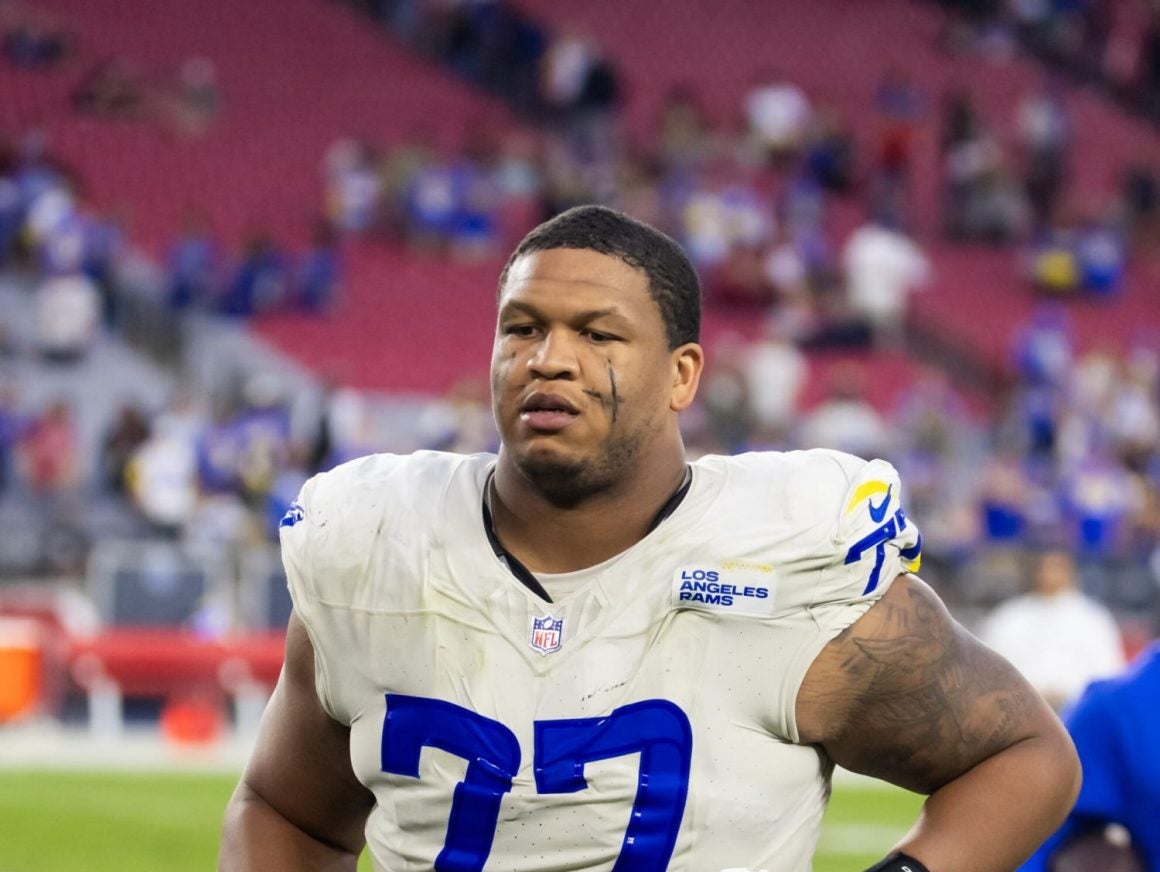
The first time most fans learn an offensive lineman’s name, something has already gone wrong.
A protection bust. A quarterback folded into the turf. The pocket collapsing like a trapdoor. That’s when the camera cuts to the left tackle and the broadcast starts talking about “pressure.” But the job of Alaric Jackson—the job of any good lineman, really—is to keep the camera bored. To make the most violent part of football look ordinary.
On a late-week practice field in Los Angeles, Jackson moves through pass sets with a steady, economical rhythm. Step. Replace. Hands inside. Reset. The work doesn’t announce itself. It doesn’t need to. Offensive line play is craft, and craft is repetition—equal parts muscle memory and attention to detail. When Jackson wins, the ball is out on time and the stadium roars for someone else.
He has built his career on that disappearing act.
Jackson never arrived with the glow of inevitability. He wasn’t a five-star prodigy or a first-round guarantee. His story is the slower kind, the kind the NFL produces more often than it celebrates: a player who becomes indispensable through reliability, patience, and an ability to absorb the league’s churn without letting it shake him.
That steadiness became more than a football trait in 2025, when Jackson faced a serious health scare involving blood clots. The season, for him, turned from weekly matchups into medical timelines. Blood clots don’t care about depth charts or contract years. They don’t respond to grit. They force you to reckon with the limits of control.
“There’s only so much you can control,” Jackson said in a Rams media session that fall. “What you can control is how prepared you are when they tell you it’s time.”
Prepared is an unromantic word—plain, practical, almost stubborn. It also happens to be a perfect summary of how Jackson has lived football.
To understand his temperament, you have to start with where he learned the trade. At Iowa, he developed in an environment that treats offensive line play as a discipline, not a brand. The Hawkeyes have long run their line rooms like workshops: hard coaching, technical demand, and a blunt expectation that you’ll do the work whether anyone is watching or not.
Even in college, the signs weren’t about flash. They were about commitment. Jackson’s decision to adopt a vegan diet—a choice that requires planning and consistency at his position—became part of his identity as a player who thinks long-term.


Los Angeles tested that discipline immediately.
Jackson entered the NFL without the protection of pedigree. His early years with the Rams looked like the early years of most linemen who arrive without first-round fanfare: spot starts, shifting roles, injuries, and the constant evaluation that comes with a roster built to stay flexible.
When the Rams’ line was reshaped by injuries and attrition, Jackson stepped into larger responsibility not as a surprise, but as an answer. Coaches leaned on him because they could. Quarterbacks trusted the left side. Over time, the tape told its own quiet story: fewer clean losses, fewer emergency throws, more snaps where nothing dramatic happened at all.
If you want a window into why Jackson’s game has traveled, listen to how he talks about preparation. In interviews and press conferences, he returns to film study—learning rushers’ tendencies, understanding how elite defenders set up counters, building confidence through information rather than emotion.
This is how linemen change outcomes without starring in them. Coordinators call plays differently when protection feels stable. Quarterbacks hold the ball an extra half-second—a small luxury that can define a season.
Jackson, for his part, has never seemed particularly interested in selling the story. His work lives in repetitions that don’t translate to a feed: the essential labor of technique, health, and consistency.
In a sport obsessed with stars, Alaric Jackson is a reminder that some of the most important excellence is quiet.
And the line holds.