
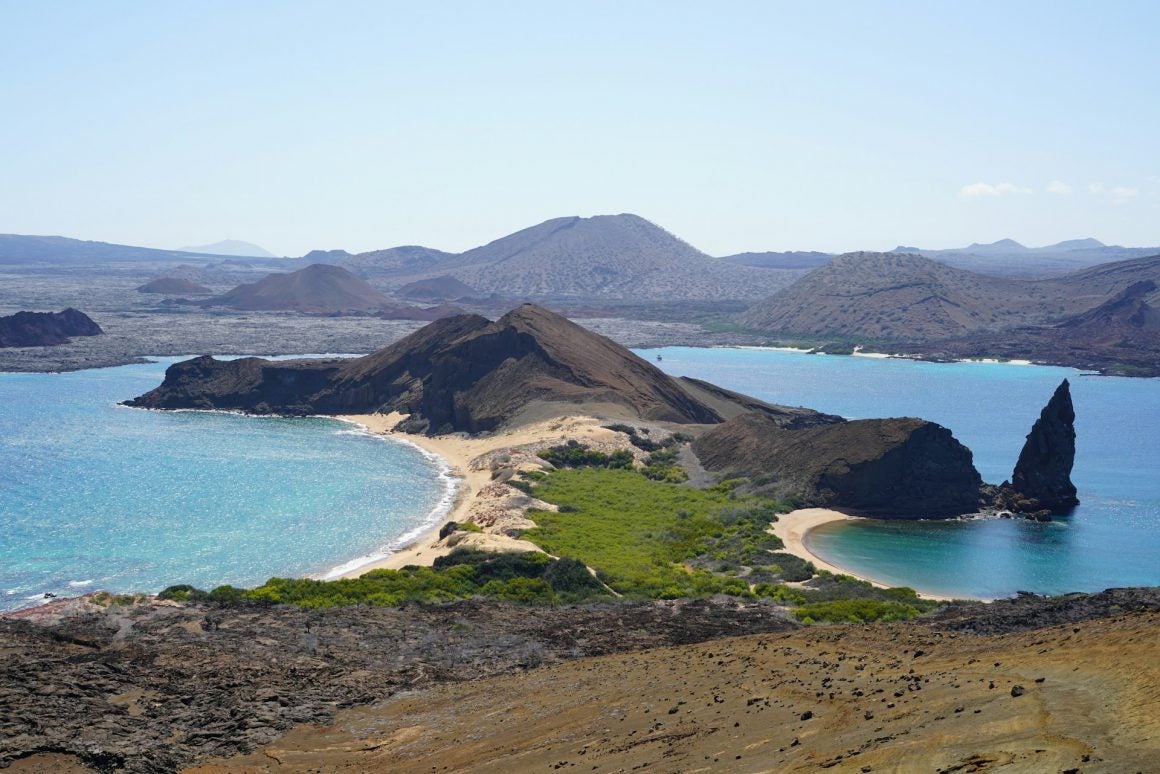
The Galápagos Islands are one of the last nearly untouched natural paradises on Earth.
Those who embrace the experience enter an entirely different world—far removed from mobile phones, city noise, and everyday stress. Encounters such as spotting giant tortoises or marine iguanas can profoundly shift one’s perspective, as humans suddenly fade into the background and the true power, purity, and fragility of life in harmony with nature become unmistakably clear.
Animals Without Fear of Humans
Due to their isolation, animals on the Galápagos Islands behave very differently than in many other parts of the world. They show little fear of humans, offering a unique opportunity for unforgettable wildlife encounters. When Charles Darwin visited the islands in 1835, he was deeply impressed by the animals’ remarkable tameness. Birds could be observed from just a few steps away, marine iguanas remained motionless on the lava rocks, and even larger animals showed no sign of flight. This is exactly what visitors can still experience today.
Giant tortoises, for example, rest contentedly in the highlands of Santa Cruz and Isabela, where they slowly roam through lush meadows or relax in the shade of large trees. Sea lions are encountered almost everywhere—sleeping on harbor benches in Puerto Ayora, playing in the water, or lounging on the beaches of San Cristóbal. In the salty lagoons near Puerto Villamil or on Floreana, visitors can spot the colorful highlights of the islands: flamingos. They stand quietly, seemingly oblivious to the world around them. Faced with such a sight, it is impossible not to pause and reflect.
Taking Home the Best Impressions: Island Hopping in the Galápagos Islands
A curated way to experience the Galápagos Islands is through guided tours. They offer access to areas that are difficult to explore independently. Travelers can choose to explore a single island in depth or embark on a multi-day journey through diverse flora and fauna. There is something for everyone, as the more than 120 islands have an incredible variety to offer.
Most visitors arrive on Santa Cruz, which has the best infrastructure and is home to Baltra Airport. A highlight is the highlands, where giant tortoises roam freely, as well as dreamlike beaches such as Tortuga Bay. At the Charles Darwin Research Station, visitors can learn more about conservation efforts and scientific research in this unique area. From Santa Cruz, journeys often continue to one of the other islands.
Isabela is the largest island in the archipelago and is especially known for its active volcanoes. The most famous of these is Sierra Negra. On a guided tour, adventurous visitors can hike up to about 1,125 meters and walk along the crater rim. From there, breathtaking views open up over one of the largest volcanic craters in the world, stretching for miles.
In addition to its dramatic volcanic landscapes, the island also impresses with vibrant colors. Hundreds of flamingos stand gracefully in the lagoons near Puerto Villamil, seemingly unfazed by curious onlookers.
Those who want to observe sea lions and discover more beaches will feel right at home on San Cristóbal. Especially in the early morning or late afternoon, visitors can encounter hundreds of these massive animals. The gentle currents make it ideal for exploring some of the best snorkeling spots, such as Playa Mann or La Lobería.
Somewhere in the Middle of Nowhere
On the Galápagos Islands, it is often possible to encounter hardly any other visitors, as the areas are vast and visitor numbers are strictly limited. One of the most remote places in the archipelago is Floreana. Here, flamingos, sea turtles, and rays are the main inhabitants.
Reaching this sense of tranquility requires a long journey. Floreana lies secluded in the southern part of the archipelago and can only be reached by boat from the larger islands. The crossing takes several hours and is usually offered only on selected days.
Yet the effort is well worth it, as this is where the Galápagos Islands reveal their most pristine side. There is little infrastructure, no large hotels, and instead an abundance of peace and quiet. This creates ample opportunity to turn inward and reflect on deeper questions of meaning. The wildlife itself can also serve as a source of inspiration.
Flamingos, for example, stand motionless in the water for hours. They seem completely absorbed in the present moment, not looking left or right. Instead, they focus solely on what lies ahead and move only when it is truly necessary. This almost meditative behavior captivates observers instantly. It is here that one realizes how calm can be found through the right focus—and that not every distraction deserves our attention.