

Most riders lose their case in the first 20 minutes after a crash.
Not in a courtroom, and not in front of a judge. They lose it on the shoulder of the road, phone in one shaky hand, while a driver who hit them is already moving their car out of the lane.
I’ve talked to enough people who’ve been through this to know the pattern. The adrenaline hits, someone yells to clear the intersection, and the only proof of what actually happened gets swept up with the glass. The fix is boring and it costs you nothing: know what to grab before you ever need it.
The short answer is simple. Photograph everything in place before anything moves, get the other driver’s insurance card live and in frame, and write down the names of two witnesses who saw the impact, not just the aftermath. If the injuries are serious or the fault is contested, that raw material is what Aiken motorcycle crash lawyers build an actual claim on, and the riders who already have it start the conversation from a position of strength.
Why the road remembers things your insurance company won’t
Motorcycles sit at a strange disadvantage in crash claims. A passenger car absorbs impact with crumple zones and a steel cage. A bike doesn’t. That means the physical evidence of who did what often lives on the pavement as a single streak of paint, a scraped mirror casing, or a patch of coolant that evaporates by the time a claims adjuster shows up.
According to the National Highway Traffic Safety Administration, motorcyclists make up a disproportionate share of traffic deaths relative to how many miles they ride. That statistic isn’t meant to scare you. It’s meant to explain why adjusters scrutinize bike claims harder than car claims. When the stakes are higher, the file has to be tighter.
Your phone camera is the single best tool you own in this situation. Use it like you’re documenting a house before you buy it, not like you’re posting to a story.
What exactly should you photograph at the scene?
Here’s the honest hierarchy, in the order I’d shoot it.
- Wide shots first. Stand where the impact happened and take four shots, one per compass direction. This maps the intersection, the lane markings, and where each vehicle landed.
- The other vehicle, dead center. Bumper damage, license plate, and the angle it’s sitting in the road. That last one matters more than people think.
- Your bike, from every side. Not just the damage. Photograph what isn’t damaged too, because a claims rep will question a bike that looks too clean.
- Skid marks and debris. Crouch low. Get the road surface in frame, not just the black streak.
- Shoes, gloves, helmet. Any road rash on the gear is proof of the force involved.
Save every file to the cloud before you leave the scene. A cracked screen or a dead battery has killed more claims than bad lawyering ever has. If you can, turn on a location stamp so the timestamps and coordinates both survive the day.
The part everyone forgets: the other driver’s paper trail
A photo of a face tells a claims adjuster nothing. A photo of a valid insurance card, front and back, tells them who’s paying. Get it in frame while the driver is still cooperating, which is usually in the first few minutes.
Ask for the driver’s name, phone number, and policy number. Write them down even if you’re shaking, because memory is the least reliable thing you’ll own that afternoon. If the driver objects, that’s not your problem to solve on the spot. Note the objection and move on.
The Insurance Information Institute tracks how claims get resolved nationally, and the pattern is consistent: cases with clear liability documentation resolve faster and closer to full value than cases built on witness recollection after the fact. Clarity is what pays.
A short evidence timeline that holds up
Memory fades fast, and the days after a bike crash blur together. I’d keep a running note in your phone that looks like this.
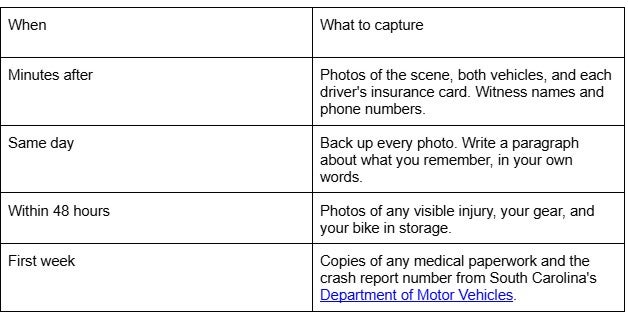

You don’t need an app. A notes file and a cloud photo album will outperform a fancy crash template every time, because you actually know how to use them at 6 p.m. on a Tuesday with your hands shaking.
Why hiring someone on day one beats calling on day 30
Most riders wait. They figure the insurance company will be fair, or they hold out hope the other driver admits fault and everyone moves on. The other driver’s insurer, meanwhile, has already started building a story that puts you at fault.
A lawyer working for you on the front end can do something you can’t: send a preservation letter to the other party, the bar owner, the intersection’s traffic camera operator, or anyone else holding footage and records before it gets deleted. That letter takes an afternoon. The same request from you, standing on the shoulder of a highway, goes nowhere.
I’d also make the call earlier than you think, not because you’re going to sue everyone, but because the first few days determine what evidence exists at all. Once footage is erased or a witness moves away, no attorney can get it back.
The mistakes I’d avoid if it were me
Don’t post the crash on social media. Not the photos, not the caption, not the comment under a friend’s post. Adjusters actively scroll for evidence that contradicts your injury claim, and a picture of you carrying a friend’s couch two days after your crash does real damage.
Don’t sign anything from the other driver’s adjuster without reading every line. A quick check in exchange for releasing liability is the classic trap, and it’s offered politely, usually while you’re still on pain medication.
Don’t fix your bike, or let anyone else touch it, before it’s been photographed and inspected. I know how frustrating it is to stare at a busted fairing for weeks. The repairs can wait. The evidence may not be able to.
So what do you actually walk away with?
You walk away with a phone full of photos, a notes file with real names and numbers, and a habit of thinking like a documentarian instead of a victim. That’s a small, repeatable process, and it works whether the crash is major or minor.
Start by saving a simple emergency folder to your phone’s cloud drive before you ever ride again. Then, the next time the tire hits the pavement on your side, you’ll already know what to shoot. If the dust settles and the other side starts pointing fingers, the riders who prepared are the ones who don’t have to scramble. That’s the whole game. Are you going to be one of them?