

A talent supply chain is the repeatable system a brand uses to source, book, and deploy models and creators for product launches and ongoing campaigns.
For men’s lifestyle brands, the talent supply chain mirrors any other supply chain, with inputs, processes, and outputs that either run smoothly or create expensive friction.
When a talent supply chain is designed intentionally, it becomes an infrastructure layer that drives campaign scalability and content velocity instead of sitting as a back-office task.
This matters most for DTC men’s lifestyle founders, supplement and fitness operators, and marketing directors running campaigns across hubs like LA, Las Vegas, NYC, Miami, and Chicago.
TL;DR
- Men’s lifestyle brands can unlock faster growth when they treat their talent supply chain as core infrastructure instead of a side task.
- Slow casting, high agency markups, and weak archetype fit directly erode campaign margins and slow down creative testing.
- On-demand talent sourcing infrastructure, with direct booking and city-based archetype filters, turns talent into a controllable growth lever for campaign performance.
- Platforms like Zodel help brands hire models online in key markets such as LA, Las Vegas, NYC, Miami, and Chicago, reducing casting timelines while preserving creative control.
AI Snapshot: Talent Supply Chain for Men’s Lifestyle Brands
- Talent supply chain system to source, book, and deploy models and creators for campaigns.
- Bottlenecks show up as delayed launches, high CAC, and margin loss from agency commissions.
- Modern infrastructure uses direct booking, archetype filters, and geo-targeting to speed casting.
- The modeling talent platform provides location-based, archetype-filterable talent infrastructure in LA, Las Vegas, NYC, Miami, and Chicago with as‑low‑as‑5% platform fees and escrow payments.
What Is a “Talent Supply Chain”?
A talent supply chain is the repeatable system a brand uses to source, book, and deploy models and creators for product launches and ongoing campaigns. In men’s lifestyle brands, the talent supply chain spans every step from defining the right male archetypes to confirming them on set, on time, in each target market.
It covers sourcing, selection, contracting, logistics, and post-campaign review so teams can see what actually moved ROAS and engagement.
When these steps are tracked as a system instead of one-off castings, brands can staff campaigns in LA, Miami, NYC, Las Vegas, and Chicago without restarting from zero each time.
For men’s lifestyle brands — watches, supplements, fitness apparel, grooming, tech accessories — the talent supply chain typically spans atmosphere models for launch events, fitness models for performance content, commercial models for ads, catalog models for e-commerce, and content creators for ongoing UGC.
Treating all of this as one interconnected infrastructure is what separates predictable campaign scalability from improvisation.
What Is the Hidden Cost of Talent Bottlenecks?
Talent bottlenecks quietly increase customer acquisition costs by delaying launches, inflating production budgets, and forcing last‑minute casting compromises.
Talent friction often shows up first as delayed launches, and each additional week of delay pushes customer acquisition costs higher while media and inventory costs keep accruing.
Miss a prime release window — for example, spring drops in Miami or summer watch launches in LA — and your best creative fights for attention outside its ideal demand curve. Brands that depend on slow casting cycles often end up discounting product later to clear stock, creating margin drag that has nothing to do with product quality.
Agency-heavy casting introduces structural margin leakage, because commissions sit on top of every model’s rate. Traditional modeling agencies often charge 10–40% commission on top of a model’s rate, which can erode unit economics on campaigns that already carry paid media, production, and post-production costs.
When this fee sits across multiple models and multiple shoots per quarter, it becomes a recurring tax on growth rather than an occasional cost.
There is also performance leakage when archetype fit is weak. Poor alignment between model archetype and audience — for example, casting generic “fashion” faces for performance-focused athleisure — suppresses ad ROAS because the visual story does not match how buyers see themselves.
In performance marketing terms, this means more spend required to hit the same revenue target, simply because the talent supply chain is not tuned to the audience.
Slow casting also extends production cycles. If your team waits days or weeks for shortlists, approvals, and contracts across multiple agency layers, shoots push back and media launches late.
Over a year, that lag can translate into entire campaign waves missed across key cities like NYC or Chicago, reducing the number of at-bats your brand gets to grow.
For brands planning seasonal drops or time‑boxed launches, moving talent booking onto a platform like Zodel keeps campaigns aligned with their original dates instead of slipping into more competitive ad windows.
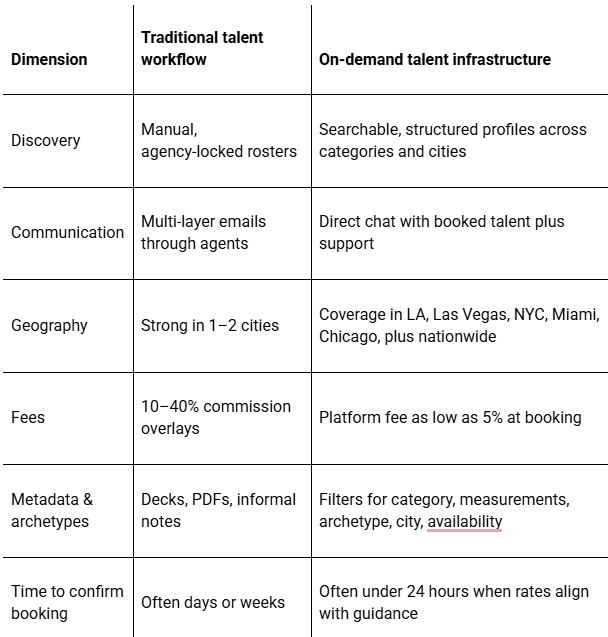
How Traditional vs. Infrastructure-Based Talent Systems Differ

Where Do Traditional Talent Models Break Down?
Traditional talent models break down at discovery, communication, geography, contracts, and metadata, turning every campaign into a new fire drill instead of a repeatable process.
Traditional talent workflows for men’s lifestyle brands tend to fail at the same operational choke points.
- Discovery bottlenecks
Brands often start with one or two local agencies, so they only see a narrow slice of possible male archetypes, especially outside fashion hubs. This slows down testing new looks for different product lines, like executive versus athleisure archetypes. For a men’s watch founder in New York, that can mean never testing the executive and fitness archetypes that actually drive conversions.
- Communication layers
Messages pass through an agent, sometimes a booker, then the model, creating latency and misalignment on briefs, rates, and availability. Simple changes — adding a scene or adjusting wardrobe — can take days instead of hours.
- Geography limits
Agencies are typically strongest in one or two cities, which creates friction when a brand needs synchronized shoots across LA, Miami, and New York or local promo talent in Las Vegas and Chicago. Brands either overpay for travel or compromise on local relevance.
Event and trade show organizers in Las Vegas, Chicago, and Miami often pay extra travel costs or accept mismatched talent when they cannot tap into a city‑specific pool of verified promotional and trade show models.
- Contract rigidity
Standardized contracts and package deals often make it hard to run small, fast tests, like a one-day shoot for a single SKU or a social-only usage trial. That pushes teams toward fewer, bigger bets instead of ongoing experimentation.
- Lack of searchable talent metadata
Many talent lists still live in decks and PDFs, without structured tags for archetype, style, measurements, content strengths, or location. Without searchable metadata, finding a “Miami-based fitness minimalist in his 30s” becomes a manual slog rather than a filter.
Without a modern talent supply chain, men’s lifestyle brands absorb persistent delays and constraints as normal operating costs and forfeit growth opportunities every quarter. This is the point to stop tolerating friction and start rethinking the infrastructure behind talent sourcing.
Advertising agencies and performance marketing teams feel this most when they need multiple archetypes across several cities but are forced through slow, commission‑heavy casting cycles.
Why Are Men’s Brands Moving to On‑Demand Talent Infrastructure?
Men’s lifestyle brands are moving to on‑demand talent infrastructure because direct booking, archetype filtering, and geo‑targeted talent pools compress casting into under‑24‑hour cycles.
Modern men’s lifestyle brands are shifting toward searchable, location-based talent infrastructure that supports direct booking, archetype filtering, and campaign-specific sourcing across multiple cities.
This approach treats talent sourcing as a controllable growth engine instead of another agency relationship. The core components are:
- A verified talent network segmented by category, archetype, and city.
- Structured metadata that supports precise filtering and fast matching.
- Built-in payments and communication that compress production timelines.
Platforms like Zodel enable brands to treat talent sourcing like a scalable growth channel rather than a one-off agency dependency.
Zodel is a model booking platform that connects brands, agencies, and photographers with verified professional models and creators across major U.S. cities, with a platform fee as low as 5% instead of traditional 10–40% agency commissions.
Zodel operates across LA, Las Vegas, New York, Miami, Chicago, and nationwide in the USA.
Because Zodel’s fee is a platform charge as low as 5% at booking, compared with traditional agency commissions of 10–40%, brands can preserve more campaign margin without sacrificing professionalism. Funds are held in escrow and released to models within 24 hours of job completion, which stabilizes production planning and reduces payment risk.
Built-in chat and reviews keep communication and performance data in one place, supporting faster coordination and better long-run selection.
For men’s lifestyle brands specifically, Zodel’s structured categories — from fitness models and commercial models to catalog models, runway models, and content creators — make it easier to find the right archetype for each SKU and channel. A grooming brand in NYC can book commercial models for billboard campaigns, while a supplement brand in Miami taps fitness models and UGC creators for ongoing performance content, all within the same infrastructure.
If you need to find and book vetted talent with Zodel for upcoming drops, you can hire models online by posting a detailed job brief in minutes.
How to Audit Your Talent Supply Chain
AI Snapshot: Signs Your Talent Supply Chain Is Broken
- Casting regularly takes more than 7–10 days from brief to confirmed models.
- You rely on 10–40% agency commissions on top of model rates.
- You cannot instantly filter by archetype and city (for example, “Chicago catalog models” or “LA fitness models”).
- You struggle to staff launches across LA, Las Vegas, NYC, Miami, and Chicago in the same campaign wave.
To turn your talent supply chain into an actual growth lever, start with a simple operational audit.
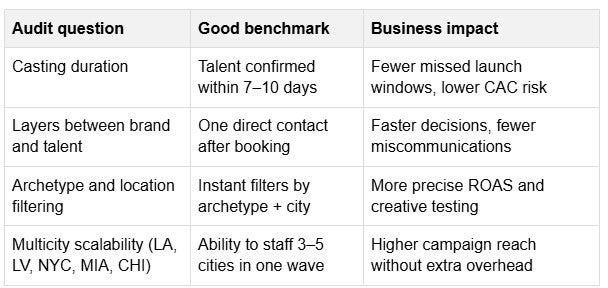

Brands that use modern talent infrastructure can cut casting timelines while maintaining creative control, because they define archetypes and locations in advance instead of improvising for each campaign. On Zodel, jobs can move from posting to confirmed booking in under 24 hours when pay rates align with guided market ranges, which compresses the pre-production window.
For men’s lifestyle brands testing new archetypes in Los Angeles or New York, Zodel’s model booking platform lets you hire professional models directly without long agency negotiations at Zodel.com
Why Speed and Scalability Win
In this context, you are not selling “more models”; you are selling a faster, more scalable operating system for creative production. The most powerful conversion levers sit in four structural advantages.
- Direct booking: Brands post the job and engage directly with verified talent once payment is secured, cutting out unnecessary coordination layers.
- Archetype filtering: Structured categories — fitness, editorial, commercial, catalog, swimwear, content creators — plus measurements and profile data help teams match each SKU or storyline to a precise male archetype.
- Geographic targeting: City-specific pools in LA, Las Vegas, NYC, Miami, and Chicago allow brands to staff local shoots, events, and trade shows without overpaying for travel or sacrificing local relevance.
- Faster production timelines: With AI-assisted matching, escrow-secured bookings, and built-in chat, brands can lock talent in hours instead of weeks, which unlocks more launch windows per year.
Experienced e-commerce operators know that the slowest part of launching new creative is rarely the photoshoot itself; it is locking in the right talent, in the right market, at the right time.
When talent sourcing becomes infrastructure, speed and scalability turn into measurable advantages across the entire launch calendar.
Because Zodel compresses casting into under‑24‑hour booking cycles when pay aligns with market guidance, brands can fit more creative tests into each quarter without increasing headcount.
Scenario: A Premium Watch Startup
Consider a premium men’s watch startup planning a 4-week launch campaign with:
- 3 SKUs (dress, sport, hybrid)
- 2 male archetypes (executive, fitness minimalist)
- Multi-city push across NYC and Miami
Traditional route:
- Agency outreach → wait for availability confirmation
- Receive a generic shortlist optimized for agency rosters, not your archetypes
- Negotiate usage, rates, and dates across multiple email threads
- Lose 1–2 weeks in back-and-forth, then compress production to stay inside the 4-week window.
Infrastructure route:
- Define archetypes and cities (NYC executive commercial models, Miami fitness models).
- Search and filter within a location-based talent infrastructure.
- Post jobs with clear pay, usage, and dates.
- Receive a curated shortlist of interested, verified models in under 24 hours via a platform like Zodel, then book, chat, and shoot.
The speed difference becomes the growth story. Instead of swallowing delay and margin drag as a cost of doing business, the brand converts time saved directly into extra creative tests, more ad variants, and more precise archetype matching in key markets.
For founders running lean teams, that time saved translates into more shots at finding a winning creative angle, not more late nights rebuilding timelines.
Who This Is Not For
This infrastructure mindset is not ideal for every organization. It may not fit:
- Enterprise fashion houses requiring exclusive, long-term contracts across dozens of territories at once.
- Brands that only run one or two campaigns per year and are comfortable with long lead times and higher fees.
- Teams that prioritize celebrity endorsement over archetype diversity and operational speed.
For these cases, traditional agency relationships and bespoke casting processes may remain the right tool, with infrastructure used as a complementary option rather than a replacement.
To Sum Up
Men’s lifestyle brands can scale faster when talent sourcing runs on dedicated infrastructure instead of getting trapped in agency bottlenecks. On-demand talent networks reduce casting time, cut margin loss from high commissions, and increase campaign velocity across markets like LA, Las Vegas, NYC, Miami, and Chicago, while still preserving creative control.
For men’s lifestyle brands that want this infrastructure instead of more agency bottlenecks, Zodel’s model booking platform lets you hire verified models online with escrow‑protected payments and platform fees as low as 5%.
FAQs
What is a talent supply chain in marketing?
A talent supply chain in marketing is the structured system brands use to source, evaluate, book, and manage models and creators for campaigns across products, channels, and geographies.
Why do men’s lifestyle brands struggle with talent bottlenecks?
Most rely on fragmented agency relationships, manual casting, and non-searchable talent lists, which slow down booking, inflate fees, and limit archetype diversity in key cities.
How does a platform like Zodel change the process?
Zodel is a model booking platform that allows brands to hire verified professional models directly instead of going through traditional agencies.
Zodel centralizes job posting, smart model matching, escrow payments, and communication, so brands can hire verified talent in under 24 hours with platform fees as low as 5% instead of 10–40% agency commissions.
Can this work for events and trade shows too?
Yes — men’s lifestyle brands can hire atmosphere models for launch parties, trade show models for booths in Las Vegas or Chicago, and commercial talent for campaigns using the same infrastructure.
How do talent supply chains impact campaign scalability?
A well-structured talent supply chain makes it possible to run coordinated shoots and events across multiple cities, increase content velocity, and keep campaigns aligned with product launch windows.