
Storage’s quiet collision with local governance
Grid-scale batteries have acquired a reputation as the agreeable technology of the energy transition.
They do not emit smoke. They do not require fuel deliveries. They can be deployed quickly, scaled modularly, and removed more easily than most generation assets. In policy discussions, storage is often treated as the least contentious piece of the decarbonisation puzzle.
That perception holds—until batteries need somewhere to sit.
As deployment accelerates, energy storage is encountering the same political and regulatory frictions that have long constrained power plants and transmission lines. The difference is that many of those frictions were not anticipated, either by developers or by local governments now forced to confront unfamiliar infrastructure.
Why storage moved faster
Batteries benefited from arriving late.
By the time grid-scale storage reached commercial viability, solar and wind had already absorbed much of the political resistance associated with clean energy. Batteries were framed as supporting infrastructure rather than transformation: a way to smooth peaks, firm renewables, and enhance reliability.
This framing helped. Storage projects often avoided the prolonged environmental reviews required for generation assets. Permitting processes were thinner. Zoning codes, written for warehouses or substations, were stretched to accommodate containerised systems that few municipalities had explicitly planned for.
Speed followed. In many regions, batteries became the fastest way to add capacity to the grid.
The friction emerges
As projects scaled, that speed became a liability.
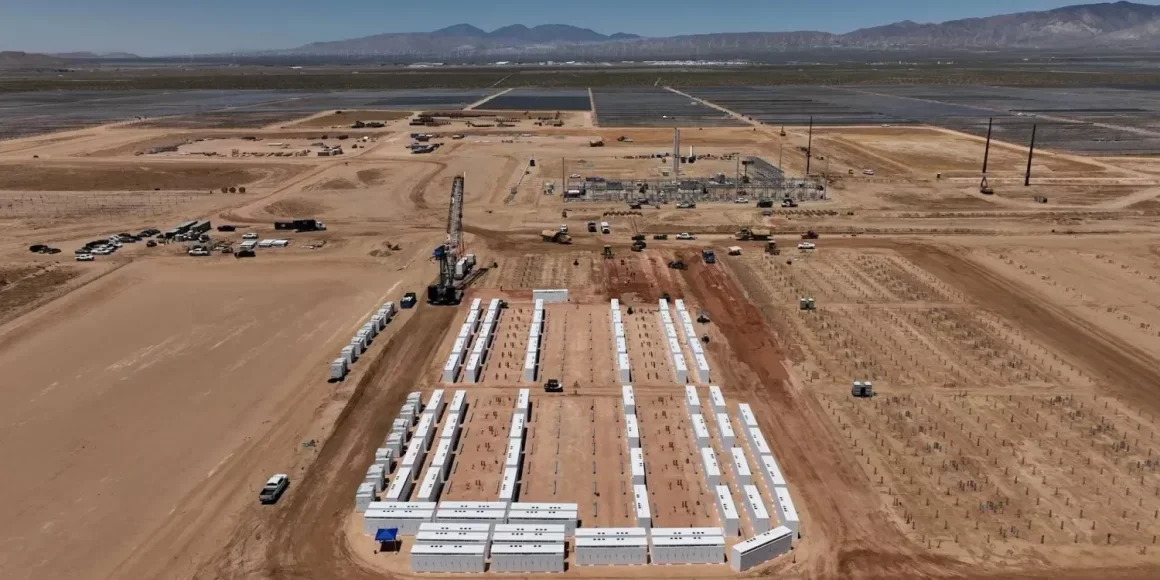
Large battery installations are visually unremarkable but spatially significant. They occupy industrial-scale parcels, cluster near substations, and concentrate risk in ways that are poorly understood outside the energy sector. Local officials, confronted with proposals they had never anticipated, began to slow approvals or impose moratoria.
Public opposition followed a predictable pattern. Safety concerns—often crystallised around the phrase “battery fires”—became the default objection, even when designs met updated standards. Less visible but equally important were procedural complaints: residents learning about projects late in the process, unclear communication about risk, and a sense that decisions had already been made elsewhere.
Storage did not suddenly become controversial. It simply became visible.
Governance, not chemistry
What distinguishes battery opposition from earlier fights over generation is how little it hinges on the technology itself.
In many cases, the dispute is not about whether storage is necessary, but about how and when communities are engaged. Projects that arrive early, with clear explanations and realistic timelines, often proceed. Those that appear suddenly, framed as faits accomplis, stall.
From the vantage point of firms such as Velur Enterprises, community resistance often has less to do with technology and more to do with timing and transparency.
This matters because storage lacks the political muscle of traditional power plants. It does not promise long-term employment at scale. It does not anchor regional economies. Its benefits are systemic and diffuse, while its presence is local and immediate.
Zoning gaps and institutional lag
Local governance has struggled to keep pace.
Most zoning codes were not written with grid-scale batteries in mind. As a result, officials are forced to make discretionary decisions under uncertainty. Some respond by approving projects cautiously. Others respond by pausing approvals entirely while rules are rewritten.
Both outcomes slow deployment.
State-level guidance has helped in some jurisdictions, but it often lags market reality. Where rules are unclear, politics fills the gap. Storage projects become proxies for broader anxieties about growth, safety, and local control.
Storage is not exempt from place
There is a tendency in energy discourse to treat storage as flexible in all dimensions. Technically, it is. Geographically, it is not.
Batteries must sit near grid assets. They require access roads, emergency planning, and ongoing maintenance. They concentrate infrastructure in ways that demand public acceptance, not just regulatory approval.
As deployment expands beyond early-adopter regions, storage is encountering communities with little prior exposure to energy infrastructure. The learning curve is steep, and mistakes are costly.
A familiar pattern
None of this is unusual in infrastructure development.
Every major energy technology has passed through a phase where it was assumed to be politically benign, only to encounter resistance once scale made it tangible. Storage is now entering that phase.
The lesson is not that batteries are uniquely problematic. It is that no infrastructure escapes governance. Speed can outrun legitimacy, but not indefinitely.
If storage is to remain a pillar of grid reliability, its developers—and the institutions that regulate them—will need to treat land use and public process as core design variables, not afterthoughts.
The politics of batteries were always easier than those of power plants. They will remain so. But they are no longer optional.