
By Dr. Brigitte Rozenberg, Founder and Clinical Director of Spinatomy Spine & Disc Centers
Do you ever feel a dull pain in your neck, like you just slept wrong, but it won’t go away?
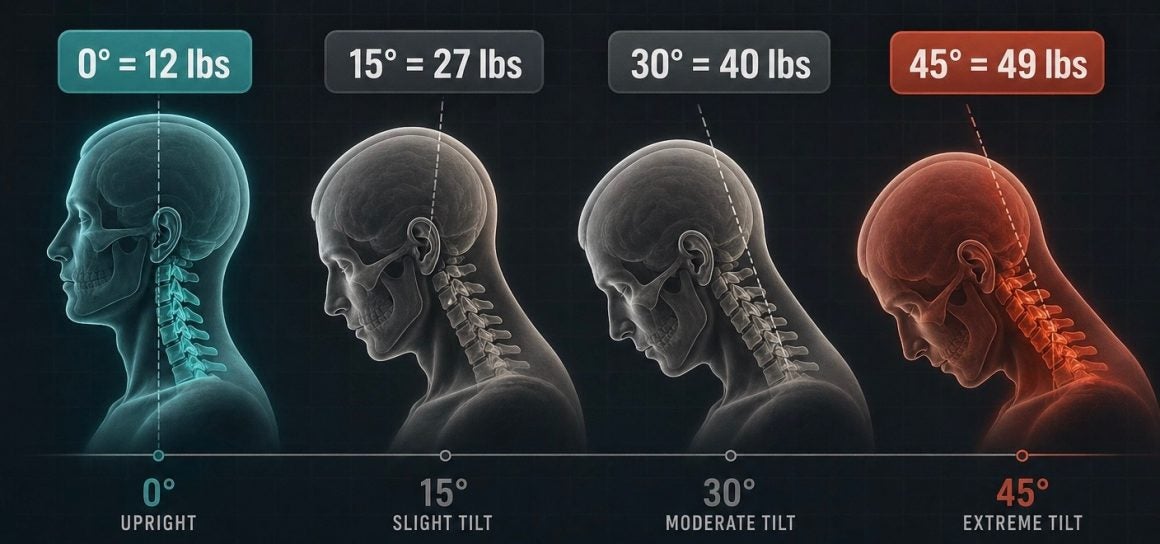
If so, that might be something called “tech neck.” Today, we spend more time than ever hunched over our computers and cell phones for both work and play. But the cumulative stress of looking down at our devices is wreaking havoc on our bodies. Thus, the idea of tech neck was born. It’s the progressive spinal damage that happens when we spend hours each day looking at our screens.
Think about it like this: the human head alone weighs anywhere from 10 to 12 pounds in a neutral position. For every inch it shifts forward, the load on the upper spine doubles. At just three inches tilted forward, your neck is absorbing the equivalent of more than 40 pounds of pressure.
As a chiropractor, I’m seeing men in their 20s, 30s, and 40s with the spinal degeneration of 50-year-olds due to years of device use with uncorrected posture. This is because the cervical discs, or the shock-absorbing cushions between each vertebra, are designed to bear load in a balanced, upright position. When the head is chronically forward, those discs are carrying a disproportionate amount of stress. Over time, this leads to disc desiccation (drying out), loss of disc height, and eventual herniation or bulging, meaning the disc material shifts or protrudes in ways that can compress nerves and the spinal cord.
Unfortunately, once the discs in your neck start to break down, the body isn’t able to reverse the process on its own. The good news? You can slow, and in some cases prevent, further damage with the right daily habits.
Eye Level is Everything.
The average person checks their phone 96 times a day. At even 30 seconds per check, that’s nearly an hour of cumulative forward head flexion. And that’s not to mention the hours spent on a laptop or tablet, too. Every degree you tilt your chin down increases the load on your neck, shoulders, and back exponentially. I recommend investing in an ergonomic computer stand and phone holder to take the biomechanical load off your spine. Focus on bringing your devices up to your level, instead of bending down to them.
The 20-20 Rule.
For every 20 minutes of screen time, take 20 seconds to look up, roll your shoulders back, and reset your posture. This interrupts the buildup of tension when your head stays forward for too long. Set a timer if you need to and treat it as a non-negotiable part of your daily routine.
Chin Tucks Over Stretching.
Most men stretch their neck by rolling it side to side, but that does nothing for alignment. A proper chin tuck, where you gently pull the chin straight back, almost as if you’re making a double chin, activates the deep cervical stabilizers that support the spine. These muscles tend to switch off with prolonged periods of tech neck. Aim for 10 reps several times a day.
Strengthen Your Posterior Chain.
Tech neck creates a muscular imbalance. The muscles at the front of the body are overactive, while the muscles along the upper back are underused. Exercises like rows, face pulls, rear delt work, and scapular retractions directly counterbalance that forward-pulling tightness. If your gym routine is only focused on the chest and front delts, you’re making the imbalance worse.
Sleep Position Matters.
Sleeping on your stomach with your neck twisted to the side for 6-8 hours every night undoes any corrective work done during the day. A neutral sleep position, ideally on your back, combined with a contoured pillow that supports the natural curve of the neck helps maintain alignment while you rest.
Your posture is first and foremost about your health. It’s one of the main components of how your body holds up over time and is so important for strength and mobility. But it’s also about your presence. How you carry yourself affects how you’re perceived in every room you walk into. Struggling with chronic pain changes your energy and your focus. In my experience, the men who invest in their spinal health early on are the ones who are still operating at their fullest capacity, physically and confidence-wise, in their 50s and 60s.