
A suit jacket that fits well can make or break a man’s appearance.
However, the right length is not the same for everyone. Taller men need longer jackets to balance their proportions, while shorter men require shorter cuts to avoid looking overwhelmed by excess fabric. Height plays a major role in how a suit jacket should fit.
Most men struggle to find the perfect jacket length off the rack. Standard sizes come in short, regular, and long options, but these categories don’t always match up with individual body types. The difference between a good fit and a bad one often comes down to just an inch or two of fabric.
This guide breaks down how suit length should change based on height. It covers specific measurements for different body types and explains what to look for during a fitting. Readers will learn how to choose the right jacket size and make smart tailoring decisions.
How Suit Length Varies With Height
Height plays a direct role in how long a suit jacket should be. Shorter men need jackets that end higher on the body to create better leg-to-torso proportions, while taller men require longer jackets to maintain balance and cover the seat properly.
Recommended Suit Lengths for Short Individuals
Men who stand 5’7″ or shorter benefit from jackets that end at the top of the curve where the seat meets the thigh. A jacket that hangs too long creates a visual break that makes the legs appear even shorter. The goal is to position the hem roughly at the second joint of the thumb with arms relaxed at the sides.
Short-length jackets typically measure 28 to 30 inches from the back collar to the hem. This measurement allows for proper proportions without excess fabric pooling at the back. Tailors who specialize in custom men’s suits in New York often adjust jacket length by half-inch increments to match individual torso measurements.
The jacket should cover the trouser waistband and zipper completely but not extend past the knuckles. Shorter men should avoid jackets with long vents or deep splits, as these add unnecessary vertical lines that further shorten the appearance of the legs.
Optimal Suit Lengths for Tall Individuals
Tall men over 6’2″ need long-length jackets that provide adequate coverage of the seat and maintain balanced proportions. A jacket that ends too high creates an awkward gap between the hem and the natural body curves. The ideal length for tall individuals extends to just below the curve of the seat, approximately where the fingers naturally curl.
Long-length jackets typically measure 32 to 34 inches from the collar to the hem. Taller frames can support this extra fabric without looking overwhelmed. The jacket must fully cover the back pockets of the trousers and sit flush against the body without pulling or bunching.
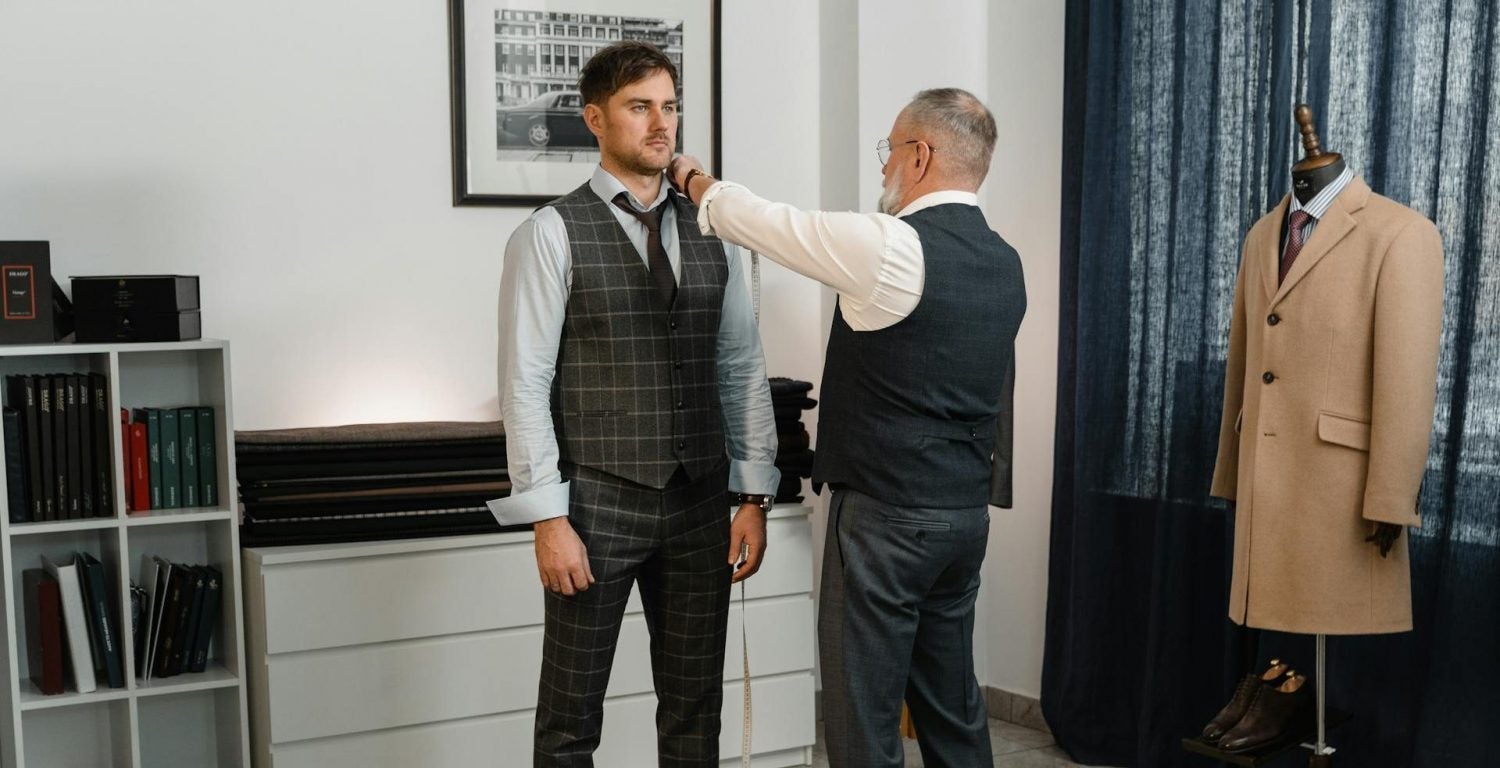
Sleeve length becomes equally important for tall men. The cuff should end at the wrist bone and reveal about a quarter to a half inch of shirt cuff. Many off-the-rack options fall short for taller frames, which makes bespoke tailors valuable for proper fit adjustments.
Guidelines for Average Heights
Men between 5’8″ and 6’1″ usually wear regular-length jackets that measure 30 to 32 inches from collar to hem. This standard length works well for most average builds because it naturally covers the seat while maintaining good proportions between the upper and lower body.
The thumb-knuckle rule applies well to average heights. The jacket hem should align with the area between the base of the thumb and the first knuckle, with arms hanging naturally. This creates a clean line that doesn’t cut the body in unflattering places.
Average-height men have greater flexibility in their styling choices. They can adjust jacket length slightly shorter for a modern look or go slightly longer for traditional styling. The key remains consistent: the jacket must cover the trouser closure and curve of the seat without extending past the knuckles or creating excess fabric at the back.
Key Tailoring Considerations by Body Type
A well-fitted suit requires attention to proportion across all body types. The right adjustments to jacket length, sleeve measurements, and trouser breaks make the difference between a suit that fits and one that flatters.
Proportion and Balance in Suit Design
The foundation of proper suit fit starts with shoulder width. The seam should end exactly where the shoulder meets the arm without excess fabric or pulling. Shoulders that are too wide create a sloppy appearance, while narrow shoulders restrict movement and cause fabric to bunch.
Jacket length depends on torso proportion rather than overall height alone. A man with long legs and a shorter torso needs a different jacket length than someone with the opposite build, even if they share the same height. The jacket should cover the seat and end where the fingers curl at the palm.
Chest measurements determine how the jacket drapes across the body. The fabric should lie flat without gaping at the buttons or pulling across the back. Most tailors recommend enough room to slip a hand between the buttoned jacket and chest.
Waist suppression varies based on body type. Athletic builds benefit from more definition at the waist, while fuller figures look better with subtle tapering. The goal is to create a natural silhouette without excess fabric or tightness that distorts the jacket’s lines.
Adjusting Jacket and Sleeve Length
Sleeve length affects the entire look of a suit. The sleeve should end at the wrist bone, which allows about a quarter to a half inch of shirt cuff to show. Shorter men often need sleeves shortened more than the standard alteration because off-the-rack suits are cut for average proportions.
Jacket length for shorter men should hit at the bottom of the seat. A jacket that hangs too long makes legs appear shorter and throws off the body’s proportions. Taller men need extra length to maintain proper coverage, typically an inch or two beyond standard measurements.
The button stance also matters for height. Higher button placement lengthens the appearance of the legs for shorter men. Taller men can handle lower button stances without the jacket looking unbalanced. This small detail changes how the eye perceives overall height.
Armhole height affects both comfort and appearance. Lower armholes provide more movement but create excess fabric under the arms. Higher armholes look cleaner and more fitted but require precise measurements to avoid restriction.
Trouser Break and Hem for Different Heights
Trouser break refers to how the pants fold at the shoe. Shorter men should choose a slight break or no break at all to avoid excess fabric that shortens leg appearance. The hem should just touch the top of the shoe with a gentle fold in the fabric.
Taller men have more flexibility with break options. A medium break creates a single horizontal fold at the front of the shoe, which works well for traditional business settings. However, many tall men also choose minimal breaks for a modern, streamlined look.
Hem length must account for shoe style. Dress shoes with higher heels need less fabric length than flat-soled shoes. The pants should cover the sock without dragging on the ground or exposing the ankle during movement.
Rise height changes proportionally dramatically. Shorter men benefit from a slightly higher rise that positions the waistband closer to the natural waist. This placement creates the illusion of longer legs. Taller men can wear lower rises without sacrificing proportion, though the fit should remain comfortable for extended wear.
Conclusion
The right suit jacket length depends on a man’s height and body proportions. Shorter men benefit from jackets that end just above the seat, which creates the illusion of longer legs. Taller men need jackets that fall below the crotch line to maintain proper balance. The goal is to find a length that covers the seat while the arms hang naturally at the sides, typically where the hand can cup the bottom of the jacket.