

The old weekend getaway was built around a hotel, a dinner reservation, and a loose idea of “seeing the city.”
The new American event trip starts with a fixed moment: a night game, a festival set, a stadium concert, a rivalry matchup, or a one-off cultural weekend. Everything else has to orbit that moment without making the trip feel like logistics homework.
That is why the smartest travel plans separate useful information from digital distractions. Flight schedules, neighborhood maps, venue policies, public transportation options, weather forecasts, restaurant reservations, and ticket availability all deserve careful attention. During the research process, travelers often encounter a broad range of online resources, from local event guides and city blogs to information about sweepstakes casinos bonuses. A well-designed itinerary stays focused on the experience itself while leaving enough room for unexpected discoveries once you arrive.
Why event travel feels different now
An event trip has a different pressure point from a standard vacation. There is one non-movable block on the calendar, and every bad decision gathers around it. A hotel that looks “close enough” can become a 45-minute post-event crawl. A late dinner can collide with gates opening. A return flight can turn a great night into a five-hour sleep experiment.
This is especially true in the U.S., where stadiums and festival grounds do not follow one urban pattern. Some venues sit inside walkable downtown grids. Others sit near parking fields, suburban campuses, transit hubs, waterfront districts, or entertainment zones built for crowds but not always for slow travel. The useful question is not only “Where is the event?” It is “What kind of city rhythm surrounds it?”
For travelers, that shifts the planning mindset. You are not just buying access to a game or show. You are buying a narrow window of time in a city, and the trip becomes better when that window has a clear shape.
Start with the fixed point, then build outward
The cleanest event itinerary begins with the one thing that cannot move. Put the match, show, festival slot, or ceremony in the center of the plan. Then work outward in layers: arrival, lodging, neighborhood time, food, movement, recovery, and departure.
A strong event trip usually answers five questions before anything gets booked:
- Can you arrive with a cushion? Same-day arrivals can work, but they leave no room for flight delays, traffic, weather, or long check-in lines.
- Is the hotel close to the venue or close to the next morning? Those are not always the same thing.
- How will you leave the event? Post-event rideshares, packed trains, road closures, and surge pricing can change the mood fast.
- What is the second anchor? A great meal, museum, neighborhood walk, rooftop drink, market, or local trail gives the trip more than one reason to matter.
- What can stay unplanned? The better the city, the more useful a few open hours become.
The goal is not to script every minute. It is to remove the decisions most likely to go wrong when everyone else is trying to make them at the same time.
Match the trip style to the event
Not every event deserves the same itinerary. A playoff game, a three-day music festival, a college football Saturday, and a major food weekend all create different travel demands. The trick is to identify the real center of gravity before building the rest of the trip.
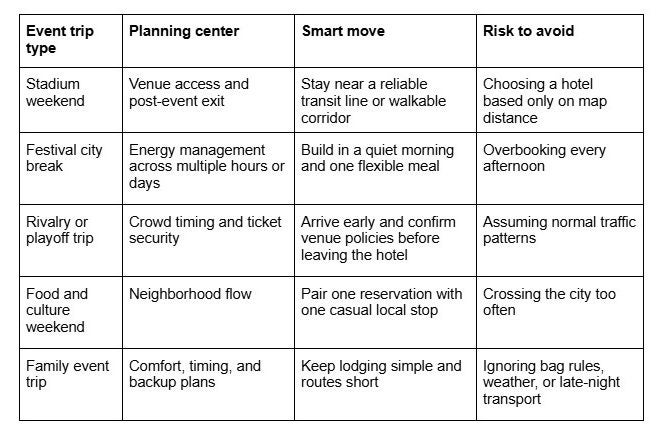
The table matters because it shows a simple truth: the event is not always the whole trip. Sometimes it is the spark. The best travel plan protects that spark without letting it burn through the rest of the weekend.
Use the city, not just the venue
A smart event trip should feel like it happened in a specific place. That sounds obvious, but many travelers move from airport to hotel to venue to airport and wonder why the weekend felt thin. The fix is to connect the event to the local texture around it.
In New York, that might mean treating a Madison Square Garden night as a reason to explore Koreatown, the High Line, or a late museum opening. In Chicago, a game can pair naturally with the lakefront, a neighborhood tavern, or an architectural walk. In Atlanta, the event district can lead into food halls, music history, and green space if the timing is right. In Los Angeles, the better plan often starts with accepting scale, then choosing one area instead of pretending the whole city can fit into 36 hours.
This is where the trip becomes more adult. It is not about collecting landmarks. It is about reading the city’s pace and choosing fewer, sharper experiences. One memorable block beats six rushed stops almost every time.
Plan for friction before it becomes the story
The difference between a smooth event trip and a frustrating one is usually not luck. It is friction management. Most problems are predictable: crowded exits, strict bag policies, mobile ticket issues, late check-ins, restaurant waits, heat, rain, weak phone batteries, and uncertainty around identity documents for flights.
A practical pre-trip check should be short but serious. Confirm the venue’s bag rules. Screenshot tickets and transit directions. Check whether your ID is accepted for domestic air travel. Choose a post-event meeting point if traveling with friends. Put a portable charger in the same place every time. These small moves are not glamorous, but they preserve the part of the trip you actually came for.
There is also a money angle, though not in the flashy way travel content often frames it. The better question is not “How do I make this cheaper?” It is “Which costs remove stress, and which costs are just lazy planning?” Paying for a closer hotel can be rational if it saves two rideshares and an hour of exhaustion. Paying for a premium location can be wasteful if the neighborhood has no connection to the rest of your plan.
Leave space for the unscheduled win
The most sophisticated event travelers are not the ones with the fullest calendars. They are the ones who understand pacing. They know when to reserve, when to wander, when to eat early, and when to let a city surprise them.
Leave one open block after arrival. Leave one slow morning after the event. Do not make brunch a competitive sport if everyone got back late. Do not schedule a museum across town when the neighborhood outside your hotel has the better story. A good trip needs structure, but it also needs oxygen.
That balance is what turns a weekend around a ticket into a real travel memory. The game, concert, festival, or cultural event gives the trip its headline. The city gives it depth. The traveler’s job is to make enough smart decisions that both can show up.