

Yes, a parking lot fall can become a lawsuit in New York, but only when the facts show that a property owner or another responsible party failed to keep the area reasonably safe, and that failure caused the injury.
A bad fall on its own isn’t enough. Whether you have grounds for a parking lot fall lawsuit usually turns on who controlled the lot, whether they knew or should have known about the hazard, and how fast the injured person acts once it happens.
Every year, visitors run into hazards ranging from untreated black ice to badly degraded pavement. But not every accident leads to legal responsibility. The outcome leans heavily on New York’s premises liability standards, its fault-allocation rules, and strict filing deadlines that can shift dramatically depending on who owns the property.
What has to be true before a parking lot fall becomes a lawsuit in New York?
A fall alone is not enough
To establish liability after a slip and falling in a NYC parking lot, you must prove several specific facts. First, that a dangerous condition actually existed. Second, that the defendant owed you a duty of care, which is the legal obligation to use reasonable care to keep property reasonably safe for visitors. You also have to show the defendant either created the hazard or knew about it, and that this specific condition directly caused real physical injury and financial damages.
Common parking lot hazards
Ordinary parking areas develop serious defects when they aren’t maintained. Think black ice, snow buildup, deep potholes, cracked pavement, liquid spills, broken curbs, poor lighting, and unmarked elevation changes. For weather hazards like ice and snow, owners are generally given a reasonable window to clear surfaces after precipitation stops—meaning injuries during an active winter storm often trigger New York’s “storm in progress” defense.
Scrutiny of parking structure safety is running high across the state right now; for instance, approximately one in five of the first 550 parking structures inspected under New York City’s Local Law 126 were deemed unsafe. Structural building violations aren’t the same as surface-level slip-and-fall liability, but the data shows why property maintenance is drawing stricter attention from regulators and the public alike.
Who may be liable after a parking lot fall?
Liability often follows ownership, control, or maintenance
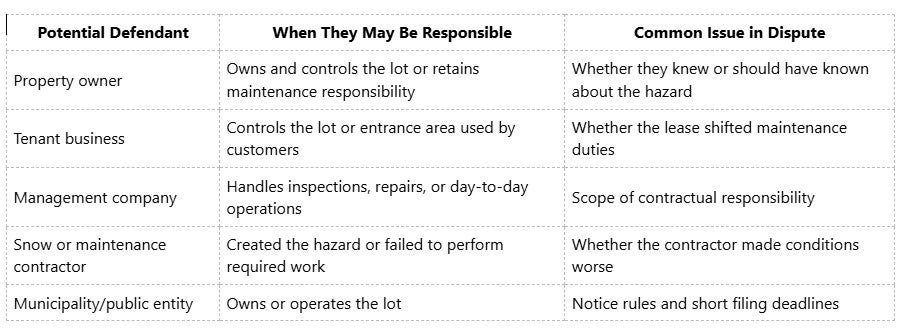
Figuring out who’s liable for a parking lot fall can get complicated fast. Liability may rest with the property owner, a commercial tenant leasing the building, a management company running day-to-day operations, or a snow-removal contractor. Sometimes it involves a municipality or public authority. And more than one party can be on the hook at the same time. A lawsuit over an allegedly unsecured employee parking lot at a hospital shows how an owner’s safety obligations can extend beyond the pavement itself to how the lot is operated and maintained.
Why notice matters
Before any of these parties can be held legally responsible, the injured person generally has to show that the defendant had notice of the hazard. Actual notice means the owner or operator actually knew about the hazard, such as when a tenant reports a massive pothole. Constructive notice means the hazard existed long enough, or was obvious enough, that the responsible party should have discovered it through reasonable inspection.
What if you were partly at fault?
New York uses comparative fault
Plenty of people assume they have no case if they missed a step or weren’t paying perfect attention. New York doesn’t work that way. Under comparative fault, compensation awarded can be reduced by your share of responsibility, but your claim isn’t automatically barred just because you were partly careless. If a jury sets your total damages at $100,000 but finds you 25% at fault for the fall, your recovery drops to $75,000.
What defendants often argue
Under New York law, defendants generally carry the burden of raising and proving comparative fault. To cut the amount they owe in a comparative fault slip and fall dispute, defendants and their insurers will frequently argue that:
- you were distracted
- you ignored an obvious condition
- you wore unsafe footwear
- you were walking somewhere not meant for pedestrians
- weather conditions were open and obvious
None of these arguments wins the case on its own. They’re factual questions a jury or judge has to weigh to decide how much the overall value of the claim should be reduced, not whether liability disappears altogether.
Does it matter whether the lot is private or municipal?
Private parking lots usually follow the standard injury timeline
Who owns the property dictates how fast you have to act. Many private-property slip and fall claims in New York have a three-year statute of limitations set by standard civil practice laws. Three years sounds generous, right? It rarely is. Security footage and eyewitness memories can vanish within weeks, so early action is advisable.
Municipal claims can move much faster
If the parking lot is owned by a city, town, village, or other public entity, a municipal parking lot injury claim triggers special, fast-moving rules. Most notably, a Notice of Claim in New York is required within 90 days of the incident, and the lawsuit itself must be filed within one year and 90 days (compared to the standard three years for private property claims).
Recent legal explainers aimed at New Yorkers stress that premises liability cases involving public entities often hinge on strict adherence to these accelerated deadlines. Missing the Notice of Claim or filing deadline can completely bar a lawsuit, no matter how strong the underlying negligence facts might be. Understanding these differences matters, especially given that while the average personal injury settlement and judgment against New York City reached $134,656 in fiscal year 2023, the median settlement remained closer to $15,000—reflecting how much timing and severity shape total compensation.
What should someone do right after a parking lot fall?
The steps you take in the first hour after a fall can heavily shape the outcome of an uneven-pavement parking lot lawsuit. Your first priority is medical attention, which helps get your injuries documented and treated. Next, photograph the exact spot where you fell, the specific hazard (place an object like a shoe, key ring, or coin next to potholes or elevation drops to establish depth and scale), the lighting conditions, and the footwear you were wearing. Report the incident to the property manager or store owner, but avoid guessing about fault in any written report.
If you can, get witness names and phone numbers. Preserve the shoes and clothing you wore without washing them, since they can serve as physical evidence. Because thousands of winter weather falls occur annually across NYC, with a clear spike during winter, property owners often clean up scenes quickly. Evidence disappears fast, especially when weather or maintenance crews alter the area, so prompt documentation is essential.
Quick answers readers usually want
How quickly should you see a doctor after a fall?
Immediately. Seeking prompt medical care creates an official record tying your injuries directly to the parking lot accident, preventing defense insurers from arguing your injuries were pre-existing or happened elsewhere.
Who is responsible if the lot belongs to a shopping center?
Responsibility could fall on the shopping center owner, a specific retail tenant, the property management company, or a contracted maintenance crew. The liable party is generally the one with legal control over the specific area where the hazard existed.
Can you still recover if you were looking at your phone?
Yes. Looking at a phone may lead a jury to assign you some liability, which lowers your financial recovery. But New York’s pure comparative fault rules mean distraction doesn’t automatically disqualify you from receiving compensation.
What if ice caused the fall?
Ice cases usually require proof that the property owner had a reasonable amount of time to clear the ice after a storm ended. If the fall happened during an active storm, the owner might be shielded by the “storm in progress” doctrine, which makes timing a critical detail.
Why do lawyers care so much about notice?
Without actual or constructive notice under New York law, a property owner generally can’t be held liable. The law doesn’t punish owners for hazards they didn’t create and had no reasonable opportunity to discover and fix.
The takeaway if a parking lot fall turns serious
A parking lot fall becomes a lawsuit in New York only when the evidence points to clear negligence, not just bad luck. The decisive questions are who owned or controlled the lot, whether that party had notice of the danger, whether your own actions played a role, and whether a private or municipal deadline applies. If the injuries are significant or the ownership of the lot is unclear, a New York premises liability attorney can help figure out the responsible parties and the exact filing deadline that applies, while helping preserve critical evidence before it slips away.