
Walk into most flower shops at 3:40 on a Friday afternoon and you will hear the same sentence: “We already closed the wire for today.”
The counter is still open. The cooler is still full. But the order you need is gone, and no amount of charm brings it back.
Every shop runs on at least two clocks, and usually three. There is the cutoff for orders leaving the building, the cutoff for orders coming in from a wire service or website, and the actual closing time on the door. Confusing them is the number one reason a birthday bouquet shows up a day late. Once you know how those clocks work, you can plan around them instead of gambling on them. Below is how to read each one, what to say when you call, and when to stop fighting the deadline and switch to same day flower delivery through a national network instead.
Why noon is the magic number at most shops
The noon cutoff is not a marketing trick. It exists because a florist’s afternoon has a hard physical limit, and that limit is the number of delivery stops one van can finish before businesses lock their doors and homeowners stop answering the buzzer.
Think about what has to happen between your call and your recipient’s front step. Someone takes the order. A designer pulls stems from the cooler and builds the arrangement. It gets wrapped, watered, tagged, and staged by route. The driver loads it, fights traffic, and works through a list that was probably set before lunch. Big cities compress this further because parking alone can eat twenty minutes per stop. Small towns have the opposite problem: fewer drivers covering wider ground.
Wire and network orders usually carry the tightest window of all, because the order has to travel through a relay before a local shop even sees it, then get built and delivered inside the same day. The florist closest to you has the loosest cutoff, because there is no middleman. That gap, often several hours, is the single most useful thing to understand about this whole system.
Cutoff clock vs. closing time: a distinction that saves you
Here is the mistake I see constantly. People treat “we’re open until 6” as “you can order until 6.” Those are different sentences, and the second one is false at almost every shop in the country.
Cutoff clock: the last minute an order can be accepted and still make today’s route.
Closing time: the moment the staff locks the door and goes home, often after finishing the day’s deliveries.
A shop can stop taking delivery orders at 1 p.m. and still be open until 6 for walk-in purchases, pickups, and orders for later in the week. If you wander in at 5 and ask for a delivery across town tonight, you are asking a driver who already clocked out to come back. Some shops will do it for a fee, most will not, and none of them enjoy the question when it arrives as a demand rather than a request.
Pickup changes the math entirely. If you are collecting the arrangement yourself, you only need it built before the shop closes, not delivered. That is often a three or four hour extension on your deadline, and it is completely free. I would take a pickup window over a rushed delivery every single time when the timing is tight.
What to say when you call a local shop
Vague questions get vague answers, and then you are back at square one. Cut to specifics. Here is the script I use:
- Name the delivery date first: “I need this delivered today.”
- Name the destination area, not the full address: “It’s near the university.”
- Ask the cutoff directly: “What time do I need to have this in by to make today?”
- Ask about the substitution policy for whatever is in season.
- Confirm the total with delivery and any rush fee before you hang up.
That fourth question matters more than people expect. Shops rarely guarantee an exact stem list, and busy holidays push substitutions further from the photo. If a specific flower carries the meaning for you, say so out loud and ask what happens if it is not available. Getting that answered on the phone beats discovering it when the box opens.
Ordering by phone vs. ordering online
Phone gets you a real answer in ninety seconds. Online gets you flexibility at 11 p.m. when no one is answering, and the shop’s website usually shows its own cutoff right at checkout. One warning about the online route: confirm which shop is actually filling the order. A local site might hand off to a national network once you pay, and the cutoff shown belongs to the network, not the storefront you thought you were supporting. If keeping the money local matters to you, ask before you type in a card number.
A deadline map for the four occasions that trip people up
Most rush orders fall into a handful of predictable buckets. Plan for these and you skip the panic entirely.
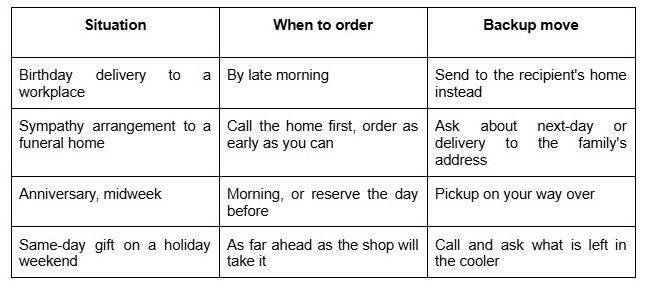
The funeral home row deserves a note. Those deliveries are not just logistics, they run on the visiting schedule, and the shop needs to reach the right room at the right hour. Call the funeral home before you call the florist and confirm when the family will actually be present. Staff at funeral homes answer that question all day, and every bit of that information protects the timing.
Small businesses in general are running shorter staffed days than they were a few years ago, a pattern that shows up in the hiring and scheduling data tracked by the Small Business Administration. A one-van shop is normal now, not an exception, and that changes what a same-day promise realistically means.
When to stop calling and switch to delivery instead
You have a hard stop. Here’s my rule of thumb: if you are past the cutoff and the flowers need to arrive today, stop trying to talk a local shop into it and use a national same-day network whose whole model runs on late cutoffs and multiple filling florists. One caveat worth knowing: these services lean on courier dispatch, so urban addresses usually get much later windows than rural routes. Saturday delivery can also appear as an option and then quietly fall away, partly because mail and courier networks handle weekend volume differently, a pattern the United States Postal Service documents in its own service standards.
If it is not today, wait until the shop opens tomorrow. A rested designer working with a full cooler beats a rushed order placed at the last minute, every time, and the price is usually kinder too.
Your best defense is a calendar reminder
Time itself is the one input in this whole equation nobody controls. The National Institute of Standards and Technology keeps the official time for the country precisely because clocks disagree, and florists are running on their own version of that problem: their clock measures drivers, not seconds.
So build the reminder. Note the birthday two weeks out, decide the arrangement five days out, and place the order before noon on the day. That habit costs you nothing and deletes an entire category of apology text messages you would rather not send. Set it for the next date on your calendar right now, before you forget, and check one cutoff before it becomes a crisis.