

In a design landscape often dominated by trends and instant visual impact, graphic designer Marco D’Aliesio is carving out a quieter, more thoughtful path.
His work is defined not only by aesthetic clarity but by intention, emotion, and a strong sense of responsibility. Emerging from Italy with a global perspective, D’Aliesio represents a new generation of designers who see visual communication as a tool for both beauty and meaning.
“My design style does not adhere to a specific identity due to its continuous evolution,” D’Aliesio explains. “However, there are certain characteristics that persist in my designs like minimalism, harmony of forms, captivating compositions, vibrant colors, and roots in classic Italian style.”
Rather than committing to a single visual language, he embraces uncertainty as part of the creative process. “Not getting attached to a specific, consistent style and questioning creative choices may seem like personal insecurity, but I believe that doubt is a great sign of openness to research and experimentation with new languages, especially at this early stage of my career,” he says. “It is necessary to grow and investigate, both individually and collectively, where design is heading.”

That openness defines not only his style but his philosophy. D’Aliesio’s work reflects a deep sensitivity to the world around him, often touching on themes of contrast, vulnerability, and social awareness. “You can perceive a great sensitivity towards external reality, a keen eye for what is happening in the world,” he says. “An attention to problems and injustices that affect the weakest. I tend to use my design with great transparency, where all my contrasts can be seen: light and dark, beauty and harmony but also the bizarre and intriguing.”
His interest in visual communication began early. “Ever since I was a child, I have always been attracted to the visual world of images and graphics,” he recalls. “I used to play at creating Vogue covers with my favorite singers in my free time.” But his decision to pursue graphic design professionally came later, during a formative moment in Rome. “I decided to become a graphic designer after attending a rights demonstration in Rome, where I realized that communication is a powerful tool for improving the world.”
Italy remains a central influence in his work. “My greatest inspiration comes from my homeland: Italy,” he says, citing influential designers such as Enzo Mari, Armando Milani, and Massimo Vignelli. He later expanded his influences internationally, particularly through Japanese minimalism. “As I continued my research, I fell in love with the minimalism of Japanese graphic design, with masters such as Kenya Hara.”
When beginning a project, D’Aliesio relies on research and intuition rather than rigid planning. “I begin my projects with research, analyzing the client’s request and creating an inspirational mood board to guide the creative direction of the project,” he explains. From there, instinct plays a key role. “Artistic inspiration is a very transcendent manifestation. I tend not to make precise plans but let myself be guided by intuitions about how I imagine the final result will be. The beauty lies precisely in the process, where sometimes you arrive at that idea or create something completely opposite.”
Collaboration is also central to his approach. “Every stage of the creative process is extremely important, from the initial inspiration to development and final refinement,” he says. “I believe the most important part is listening to the client and finding a balance between their request and your own creative language.” When a project stalls, flexibility becomes essential. “If a project doesn’t work out, I would take two approaches: either I would try to improve and revamp the project to give it a new identity, or I would start a project from scratch.”
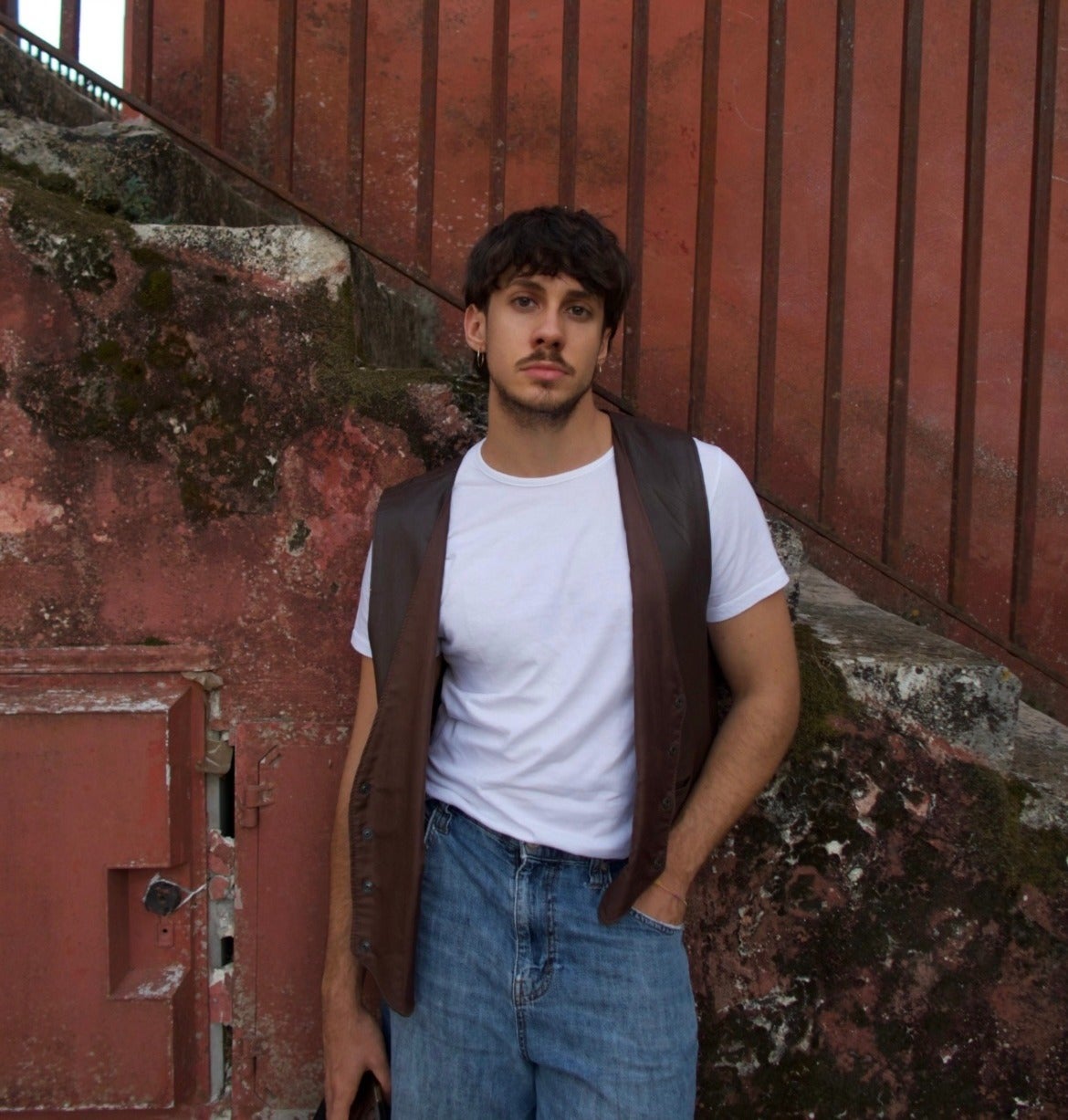
Today, D’Aliesio draws inspiration from both people and emerging creative communities. “I am inspired by vulnerable people and minorities who find courage and speak out for their rights,” he says. He also looks to small experimental studios and vintage materials for new ideas. “In web research, social media, fashion, and entertainment, but above all by leafing through vintage books and magazines that have very interesting contents with the potential to be adapted to contemporary language.”
Like many emerging creatives, he acknowledges the challenges of building a career. “What I have understood so far is that a successful career is not a bed of roses where things always get better,” he says. “Setbacks, rejections, and moments of uncertainty are essential for healthy and conscious growth. The hardest moments are the ones where we evolve.”
Among his proudest accomplishments is his thesis project, where he first used design as a form of advocacy. “My thesis project is the one I am most proud of because, although it was not graphically mature, it was the first time I used design to raise awareness and defend human rights through vibrant, pacifist visuals.”
For D’Aliesio, design carries responsibility. “Designers have a powerful communication tool that can raise awareness, educate, and influence the world,” he says. He hopes viewers experience emotional depth in his work. “An initial feeling of stunning at first glance, with a touch of perplexity, then entering into the design and leaving a feeling of peace and a glimmer of hope.”
Looking ahead, he is expanding into motion and video design. “My biggest challenge lately has been to cross over from the world of static design to video one, with animations, editing, and motion graphics.” He is also mindful of technological shifts. “I am frightened by everything related to the world of artificial intelligence, where important steps in the human creative process can be lost.”
Ultimately, his ambition is simple but meaningful. “I want to be remembered for generous, brilliant creative projects with messages of peace that, in my own small way, can help make the world a more inclusive and loving place.”